What We Strive For With Our Pups
We want our pups to go to our forever homes. Because of this, we go through an interview process, and we expect to be interviewed as well to pass your own standards for getting a PWD! Our puppies go through desensitization training that starts with tickles, kisses, being on their back, etc., when they are young. The training continues throughout their time with us, and escalates with their awakening senses, but not to any traumatizing degrees. Eventually, we want your pup to not react too poorly to a vacuum, doors shutting, thunder and fireworks, music playing, keys jangling, etc. We also give them a very healthy and rich diet for this critical time in their tender little lives, and expect care to be given to their diet in your home as well to avoid common pet issues pertaining to that. A lot of love, time, and money goes into raising these pups, and we are so excited to unite them with their forever homes whenever possible, so please bear with our questions, it's out of everyone's best interest, I promise.
Puppy Care Packages
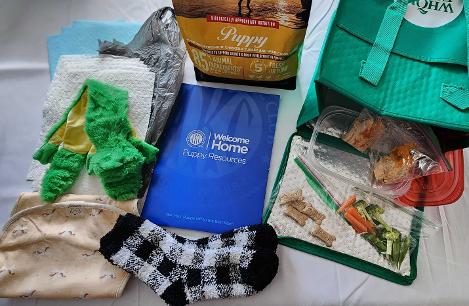
Puppy Care Packages Include:
- An insulated tote bag. This is to keep their things temperature regulated, tidy and controlled in the possible chaos of getting a new puppy.
- A small bag of Orijen Puppy kibble. This will last you a long time, I expect 2-3 weeks with 3 meals a day). This is a trusted brand of dog food that helps keep puppy poos regular while making sure they're getting their dietary nuance needs met.
- A week or so of cooked puppy food. This will be the 'wet' food that your puppy grew up eating with us! We slow-cook pork loins with peeled sweet potatoes and carrots throughout a day, and it keeps in the fridge for a week at a time. Expect the little tupperware in the bag to be full, the picture just shows individual servings in ziplocks, which some owners appreciate for measuring out meal sizes for their new puppy~). Half of this food will also be frozen, to help keep the other food cool.
- A collapsible water bowl and bottles of water. Not in the picture! We do want to make sure you have all you need for your trip back, though. If you're taking a flight, then feel free to empty the bottles for the flight, and refill after landing, in case you have some driving to do after.
- Healthy (and unhealthy) snacks. Our pups have always been little omnivores, and they tend to take well to their veggies. Broccoli and carrots can be great for working those new teeth on, and are small/wet/angular enough to not be too high a choking hazard - but always best to keep an eye on little ones eating food until they figure it out with confidence!) We also do cave in and let our dogs enjoy Milk Bones, they truly love them, but all good if you don't want these packed with your pup(s).
- Mess cleanup tools. We will arm you with piddle pads, paper towels, and a grocery bag, in case your little one makes a little accident in the car or in their crate.
- Your puppy's featured photo cloth. These are actually burp cloths, haha, but they're so very cute. I try to get you set up with a pattern you can see, and refer back to in puppy photos to really appreciate how big or small they were at the time of that picture. It'll be nice to hold the fabric your puppy grew up with while looking back on the photos you got to see before picking your new family member up (I hope!).
- A crinkle toy that smells like their littermates. A piece of home to take with them. You're their new family, but we believe that this, and the cloth you sent in, can help with the transition into a new life. We also prefer crinkle toys over toys with stuffing, as our dogs very, very reliably dig out the stuffing and the squeakers and, sometimes, eat the stuffing. Watch out for that, haha!
- Your clothing returned back to you. We just ask that it's not anything overly personal. A shirt, or some socks, are what we usually get sent (in a ziplock bag for freshness) to get a good whiff of you before ever meeting you, helping to normalize that smelling you still means food is coming and fun times are still ahead, despite all the new things.
- Your AKC packet, in which will be all of the following:
- AKC new puppy papers.
- Your deposit check. Not in the picture, but if your deposit took this preferred method, then expect it back with your paperwork in exchange for puppy payment.
- Your puppy's litter pedigree.
- Your copy of our Burntwood PWD puppy ownership contract.
- Your puppy's immunization pamphlet. (we recommend you schedule for their next vaccines soon after pickup, to make sure your vet isn't booked out!)
- A quick reference sheet we made with some common advice for your new family member.
- A little something from me to you~
Whelping and Rearing Pups
Conception and Pregnancy: Puppy care doesn’t begin when they’re born. It begins with selective breeding, high standards, quality care, and seasoned breeding insights (we even know the window of time they should tie to conceive, without going to the vet for hormone testing). Our sire is given a boosted protein diet to carry him through the heat cycle (as he’ll start to lose his appetite as well once the cycle deepens), and afterwards, our dam will follow a diet that supports both her health and healthy puppy development. The dam’s diet will continue to be enriched throughout nursing, and then enter a recovery phase for several months after in preparation for the next litter (in about a year - we avoid back-to-back breeding).
Birth: Ever since we began raising puppies, every litter has been born and kept in close proximity, as it’s important to us to be right next to our puppies and their mom. We are very present for the whelping, and all our pups enter this world into our hands. We assist the mother if they need it, clamp and clip the umbilical cord, aspirate the mouths and noses and dry them, and mom is left to love on and clean them to her liking while we record the pup’s data and take pictures. Once she’s content, we assure that the newborn latches, and they nurse with their littermates until the next pup is born. We are generally doing this from the evening hours (around dinnertime) through to dawn. We massage the mother’s back, comfort and corral the wriggly ones, and foster as safe and calm a deliver as possible, loving on all.
Newborns: Newborn pups are very smell- and touch-oriented, as they come into this world blind and deaf. It may seem like a good time to not do much outside of monitored nursing, supplemental bottle feedings, burping, assisted relief, and weight tracking (plus pictures. All the pictures.), but these senses are very important for a dog to normalize human activities and oddities with. Because of this, we spend time each day holding each puppy, walking around their room with them, and cooing at them against our neck and chest with little bounces in our arms (or, hands). This allows them to feel and hear us, and to prepare themselves for all the wonderful and stimulating experiences life will offer.
Toddlers: As their eyes and ears open, their stimulation exposure increases as well. They don’t have teeth yet, but they’re starting to sit upright, and may stare in a daze at the wall of their whelping box, or at another puppy, as their eyes start to come into focus. In this phase, we enjoy letting them listen to music with us, or listen to the TV. We bring in clicker clackers, things that jingle and jangle, and give them toys that crinkle and rattle (though they tend to ‘fwump’ over them more than walk, still). We’ll also make sure to vacuum in the next room during this time, honk a car horn outside, and listen to recordings of thunder storms and fireworks (though the real things are more intense). One of my favorite things, though, is when we get a puppy who will go from being in a daze, to realizing your nails are rustling the piddle pad in front of them.
Runners: This is a transitional period, from easier to clean whelping boxes to the beginnings of the waking nightmare. There is nothing more tempting for a brat to go interact with than a fresh and stinky dark brown thing sitting on a pristine canvas of piddle pads. Momma will start to ween them at this point, and we can’t blame her as their nails seem to regrow within hours of trimming down for her poor belly. Their teeth start to poke through, starting with the fangs, and the one thing they wish most to do is to use them. Usually on one another. Especially if it means getting your littermate to roll over the stinky dark brown thing. They start to get introduced to how they’ll be finding some of their meals at this stage as well. Exposure is still happening regularly, with scary sounds happening closer for longer, and basic grooming sensations (such as brushing and nail clipping) happen regularly. This is also the stage when we begin to welcome possible future owners to visit (about three weeks old)
Gnawers: This phase, momma starting to want to pull away from nursing. They know her smell and her sound, and they will wake up and stop playing and storm the walls of their pen yapping for her to feed and love them. They start to recognize toys as toys, rather than pillows and obstacles, and they puppy-prance around their whelping box, a clear sign they need to be upgraded to a puppy pen soon. They get time to nurse, then meals presented in no-tip bowls, consisting of goat’s milk, cooked rice, and a bit of minced cooked meat. We will also start to grind up a high-quality puppy kibble, and sprinkle that in, more and more, with their milk, transitioning them and their tummies towards their next dietary phase. Sensory exposure and stimulation is still very much at play in this stage, but our pups tend not to notice our efforts at this point, even when we try to get more creative.
Yappers: At this age, we move them to a central part of our home. This is a perfect opportunity to integrate them in to our daily life and develop their socialization skills. They hear the sounds and experience the smells they will live with the rest of their lives. Each day I begin my morning with them. I crawl into join them, clean the area and play with them for a long time, until they take their first nap. Throughout the day their parents play with them, touch noses if they are not out of their play area and learn to chew on good things. We put a small kennel or two in their area to accustom them to crate training, but the doors are off the kennels. They love to sleep and play in the kennel, but they also crawl all over them. They are piddle pad trained here which will help with house training.
Puppies: We keep our pups until they’re eight weeks old, giving them time to know that they are dogs, not people, and socializing them to how their mom attempts to communicate with and curb them (rather than just their littermates), which is an important step of socializing them. At this stage, momma isn’t nursing them anymore, and they’re transitioning fully off milk onto a healthy diet, learning to chew their food (and, ideally, not to step in it, or worse). They have moved into a puppy play pen, which is attached to their first kennel, a dark and comfortable space to retreat to for sleeping and to help them learn to separate sleeping area, food area, and play area, from a potty area. Little reprimands begin at this phase, establishing people as authority figures, and little games are pursued, such as fetch (yes, young puppies can play fetch!). While it’s our job to socialize them properly during this phase for transition from our family to yours, it will still be on you to establish your role as leader to your new family member, and to start staying true to the expectations of the house. If you’ve already picked a puppy from us, then this is the time when we may ask for you to mail us a piece of their new home (an unwashed shirt, a blankie, a toy that you washed then kept in your pocket, etc.) to start to get to know you through. Once you pick up your puppy, whatever you sent will be given back, unwashed, so that your puppy can take a piece of the home they’ve grown up in with them into their new life with you.